
Jaws Pattern
Jaws Pattern
Technical Indicators • Price Action • Chart Signals
A momentum structure formed by diverging smoothed moving averages signaling trend strength or exhaustion
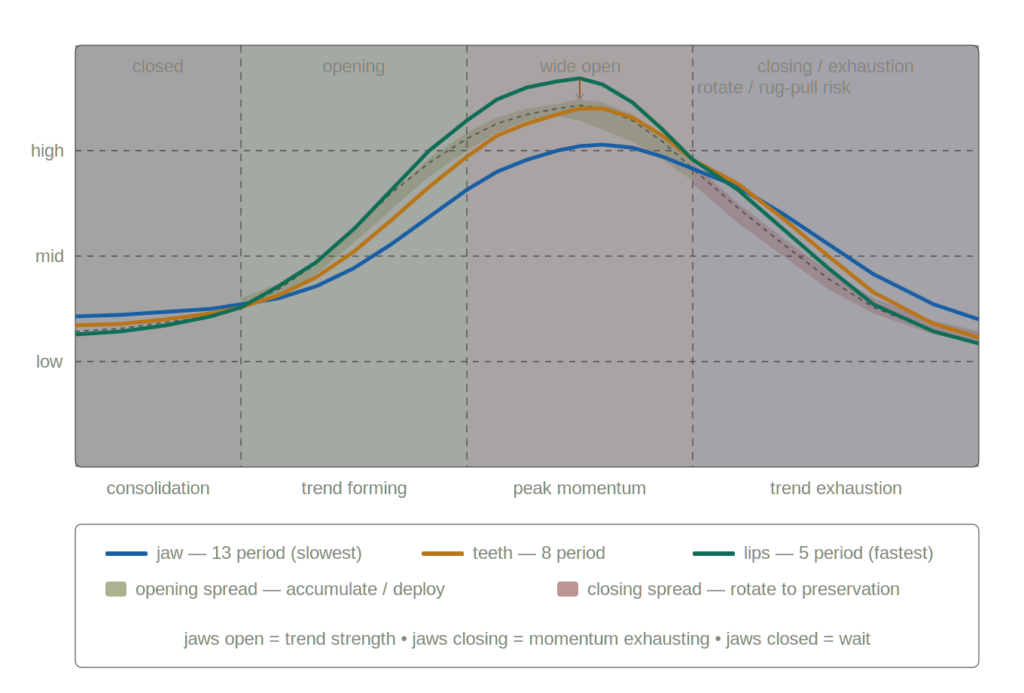
Jaws Pattern refers to the visual spread formed by the three smoothed moving averages in Bill Williams' Alligator Indicator — the Jaw (13-period), the Teeth (8-period), and the Lips (5-period). When these three lines move apart and widen, the Jaws are said to be open — signaling that a strong directional trend is forming and momentum is accelerating. When the lines converge and tighten, the Jaws are closing — signaling consolidation, weakening momentum, or an impending reversal.
The wider the spread between the three lines, the stronger the trend. A fully open Jaw pattern on a higher timeframe — weekly or monthly — carries significantly more weight than the same pattern on a lower timeframe. The Jaws Pattern is not a standalone trading signal; it is most powerful when confirmed by additional inputs across a broader convergence stack.
In a cycle-aware framework, an opening Jaws Pattern on the BTC weekly chart during an accumulation phase is one of the clearest early indicators that a new trend leg is beginning. A closing pattern near a cycle peak, combined with sentiment extremes and on-chain divergence, signals that the trend is exhausting and rotation into preservation is warranted.
Use Case: A cycle-aware investor monitoring BTC on the weekly chart notices the Jaw, Teeth, and Lips lines beginning to widen after a prolonged consolidation period.
The spread increases over three consecutive weekly candles while volume rises — confirming the Jaws are opening and a trend leg is forming. This becomes one input in a broader multi-signal convergence scan.
When the Jaws eventually begin closing near a cycle peak, gains rotate first into C1USD on the Kinesis platform to earn while waiting, then sequence into ETH, XRP, and finally into $KAG and $KAU for metal-backed transaction fee yield and long-term preservation.
Key Concepts:
- Multi-Signal Convergence — decision framework requiring multiple independent signals to align before acting
- Temporal Pattern Recognition — identifying recurring market behaviors tied to time-based cycles
- Rhythmic Market Awareness — reading the natural cadence of market movements across timeframes
- Trend Exhaustion Indicators — signals that a current trend is losing momentum and nearing reversal
- Cycle Cadence Map — framework for mapping the sequence and timing of market cycle phases
- Synchronicity Signals — simultaneous alignment of multiple market indicators across timeframes
- Relative Strength Index (RSI) — momentum oscillator used to confirm or contradict a Jaws Pattern reading
- Support Levels — price floors that interact with Jaws structure during consolidation phases
- Resistance Levels — price ceilings that a widening Jaws Pattern must break through to confirm trend strength
- Peak Sentiment Overload — extreme crowd euphoria that often coincides with closing Jaws at cycle peaks
Summary: The Jaws Pattern translates the spread between three smoothed moving averages into a visual momentum read — wide Jaws confirm trend strength, closing Jaws signal exhaustion. As one input within a multi-signal convergence stack, it becomes a reliable cycle-phase confirmation tool rather than a standalone trigger.
Reference Table — Jaws Pattern States
Framework — Reading the Jaws Pattern Across Mindsets
The Active Trader watches the Jaws on the 4-hour and daily chart for short-term momentum entries. An opening Jaw with rising volume is an entry signal. A closing Jaw is an exit or short signal. Speed matters — the trader acts on the first confirmed candle after divergence begins.
The Long-Term Holder watches the Jaws on the weekly and monthly chart only. Short-term noise is ignored. An opening Jaw on the weekly BTC chart after a prolonged consolidation is a high-conviction accumulation signal. The holder adds to position and waits for the wide-open state before reassessing.
The Yield Architect uses the Jaws Pattern to time deployment of yield positions. An opening Jaw signals the right moment to activate staking, delegation, or liquidity provision — capturing yield during the strongest part of the trend leg rather than the exhaustion phase.
The Sovereign Wealth Builder watches the Jaws closing on the weekly chart as a rotation trigger. When momentum exhausts at a cycle peak, capital exits speculative positions and moves into C1USD to earn while waiting, then sequences into $KAG and $KAU for transaction fee yield and metal-backed preservation through the contraction phase.
Checklist — Jaws Pattern Confirmation
- Timeframe confirmed — weekly or monthly for cycle-level reads, daily for swing entries
- All three lines identified — Jaw (13), Teeth (8), Lips (5) visible and labeled
- Direction of spread confirmed — lines actively diverging (opening) or converging (closing)
- Volume cross-referenced — rising volume on an opening Jaw strengthens the signal
- RSI checked — confirm momentum is not already overbought on an opening Jaw signal
- Pattern not treated as standalone — at least one additional signal from the convergence stack confirmed
- Cycle phase mapped — opening Jaw in accumulation phase carries more weight than in peak phase
- Closing Jaw at cycle peak triggers rotation plan review
- Preservation destination identified before acting — C1USD, $KAG, or $KAU rotation targets set
- No action taken on closed Jaws — flat intertwined lines indicate no tradeable trend
Capital Rotation Map — Jaws Pattern Signal by Cycle Phase
Jaws Pattern Cycle Map — open Jaws confirm trend entries; closing Jaws trigger preservation rotation before momentum fully exhausts.